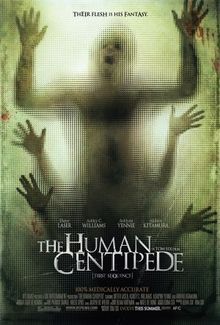
The Human Centipede: Good or Not Good? Not Good

Oh dear, I have bad ideas sometimes. The last one I had I mentioned to my ever-lucubrating, elfin pal Kay.

After listening to its bare bones she said, approximately, “In the name of fucking sanity never ever ever mention that to anyone. Don’t blog about it. Don’t put it on Twitter. Don’t put it on Facebook. Just forget you ever had it.”

And that is where I am superior to Tom Six, because where I have a network of normal people who will, quite proactively, remind me where the boundaries of acceptability lie, Tom Six apparently does not. He has a network of dimwit enablers who say stuff like “Hey Tom, that revolting idea rocks. You should make a film out of it you sexually uninhibited spliffy-boy.”

He’s Dutch, you see.

I do a great impression of Dutch people. Ahem. “Hey, thish land ish a bit marshy and shoggy. Shince it ish sho difficult to reclaim let ush build our buildingsh tall to maximishe living shpace per unit area. But alsho, let’sh shublimate our anger at thish into making Dutch cuishine the flattesht, mosht shpace conshuming cuishine in the world. Bring on the pancakesh!”

Ooh. It’s gone very quiet in the room. Bit racist? Sorry. I love Holland and spent some very happy time in Amsterdam. If you haven’t been there you should go. Before its nearest neighbour is the Lost Kingdom of Atlantis.

So anyway. Tom Six’s revolting idea is that, if you are a demented surgeon, you can stitch three humans together (mouth to anus) to form one long creature with a single digestive tract.

Yes, exactly. A striking idea, but not a story. Nevertheless he has made a feature film out of it, The Human Centipede (First Sequence).

Body horror, a distinct sub-category of horror, has a history that is long and, surprisingly, far from ignoble. There was a change in American film-making around the mid to late sixties that allowed more explicit sex and violence into what were perceived as sensible, adult movies rather than puerile drive-in fare. Bonnie and Clyde is regarded as something of a turning point.

One of the resultant effects of this was to enable seriously intentioned filmmakers to smuggle interesting agendas into populist and profitable entertainments. Graphic depictions of violence enabled directors like Wes Craven and George Romero to make gooey horror films that were also explicit criticisms of American involvement in Vietnam.

Craven, after a few stutters, went onto the broad pantomime of the Nightmare On Elm Street movies before steering that series provocatively into reflexiveness with Wes Craven’s New Nightmare and following this up with the auto-critical Scream Trilogy.

Romero is a more interesting director, and I am sure more intelligent people than me have written theses about his work. What is pertinent here though is to point out how he worked the horror genre to specific ends.

His 1968 movie Night Of The Living Dead remains a landmark movie in many ways. Shot in cheap black and white it still looks tremendous. It has the imagination to render one of its central characters permanently mute with terror after her ordeal in the opening minutes of the film. The central competent character is a black man; the white characters are variously unsympathetic, dim or venal. The film even underlines its view of the futility of conflict by having the hero shot in the head at the end by redneck would-be rescuers. It’s a magnificent film.

With the two follow-ups Dawn Of The Dead (1978) and Day Of The Dead (1985) Romero used the genre to comment acerbically on the deadening passivity of materialism and the misappropriation of science by the military-industrial complex respectively.

He’s not just pissing about you know.

To a great degree horror films have always reflected the times in which they were made, and the fears that pertained at the time, be it fear of sexuality, communism, atom bombs or the passing of power to the next generation. In the seventies though this was much more of a conscious expression than a subconscious one and it reached its apex in the pioneering body horror films of Canadian director David Cronenberg.

These days he’s perhaps better known for adapting supposedly unadaptable literary works (Crash, The Naked Lunch, M. Butterfly, Spider and A History Of Violence) but his most recent original scripts “eXistenZ” and Eastern Promises still have an overwhelming physicality about them.

Cronenberg’s early body horror works Shivers, Rabid, The Brood, Scanners, Videodrome, Dead Ringers and The Fly are extraordinary movies. He also directed an adaptation of Stephen King’s The Dead Zone which, whilst non-negligible, feels a bit out of place in the oeuvre, a slightly compromised populist piece.

The Dead Zone aside though, his films are all manifestly the work of an auteur. Typically dealing with reactions to bodily invasion, sexually transmitted disease, birth trauma, tumour growth, parasites and corruption of the flesh the films can be repellent and alienating (particularly given some of Cronenberg’s bizarre casting choices), but, importantly, they are all clearly the end product of a long and informed intellectual process. Further they have something quite significant to say about humanity’s ongoing attempts to remove itself from an organic environment into a neurotically clean, antiseptic one.

Philosophically, the only film I’ve seen recently that stands with Cronenberg’s work is Lars Von Trier’s majestic Antichrist which also equates the fall from innocence with the estrangement of nature.

Tom Six has clearly watched a lot of Cronenberg, and this has been his explicit influence in the crafting of The Human Centipede (First Sequence). Unfortunately Six seems to lack Cronenberg’s academic ambition and rigour, and has decided that the depiction of the vile is somehow just as good as the exploration of the vile.

Bad news Mr. Six. It ain’t.

I’m not sure if the addition of a plot or sympathetic characters would have changed my negative opinion about The Human Centipede. I rather suspect not, because it isn’t just the inability to develop the situation that is wrong with The Human Centipede. There are is also an unpleasant set of underlying assumptions at work that perturb me.

I watch a lot of films you really wouldn’t want to see. I’ve got base tastes. I accept that, and really as long as there’s plenty of embonpoint on display, some ludicrous fantasy violence and a Euro-disco score then I’m likely to be happy. My inner critic isn’t riled by much, but there are a few films (excluding obvious atrocities like Pretty Woman, Ghost and Die Hard 2) that have made me question why I watched them.

Firstly there is The New York Ripper. This is a 1982 rip-off of Brian De Palma’s Dressed To Kill (itself a rip-off of Psycho) directed by Lucio Fulci. I love Fulci and his lurid, OTT directorial style, but there’s a gloating misogyny to The New York Ripper that stops it from being entertaining on any level. Poor show, Lucio.

Secondly there is I Spit On Your Grave (1978) which occupies a uniquely ambiguous place in cinema ethics. Shoddily made and with only one good performance (Camille Keaton – Buster Keaton’s grand-niece fact fans), the film concerns itself for half of its length with the brutal violation of a New York woman holidaying alone in the country. The second half of the film deals with the woman’s (supposedly redemptive) murderous revenge. There is a school of thought that this is a film of feminist empowerment, one backed up by the film’s opportunist alternative title Day Of The Woman. Personally I think that if the director had intended that he wouldn’t have spent quite so much time depicting the defilement. Bloody hell, it makes Michael Winner’s Death Wish look like the moral equivalent of Crime And Punishment, but hey that’s just my opinion.

And now we have the Human Centipede (First Sequence). Technical virtuosity aside (and it does look pretty authentic) there’s nothing good here. There’s no moral debate. There’s no character identification. There’s not even the feeble justification of a developing narrative. There’s the idea, and that’s all.

Add to that the fact that the victims are two attractive young American women (segments two and three of the centipede) and a male Japanese tourist (segment one) and you have a grim, leering confirmation of every suspicion of Europe that the grunting, idiot makers of the Hostel films harbour in their minuscule minds.

There’s another film coming apparently, alluded to in the subtitle of this one. The sequel The Human Centipede II – The Full Sequence will have a twelve-person centipede (still nowhere near a hundred legs I can’t help noticing) and is currently filming in London. It opens in 2011.

How are you going to shock us this time Mr. Six? I’ve got an idea. The Human Centi-paedophile. You can have it for free.

Just a bit of fun eh? Does no harm.

Right.

***

As a postscript, my bad idea that Kay said to shut up about. It’s not gross or anything. It’s just, you know, unacceptable.

There’s still one percent of my brain that reckons it’s worth exploring.

Maybe I’ll blog about it after all…

On Her Majesty’s Marty McFly Scape

What a droll old cove that Christopher Nolan is. He claimed with Inception that he wanted to create the same kind of effect that Star Wars had had on him as a child. He had no idea, he said, what Star Wars was about when he went to see it for the first time, and that sense of explosive discovery was what he wanted to emulate with his first movie since 2008’s The Dark Knight.

Well, I can’t speak for Christopher Nolan’s childhood, but I do know that by the time Star Wars opened in Leeds (and I went to see it first pretty early in its first run) I already had the souvenir magazine, four poster magazines, the soundtrack and 65 of the 66 bubble gum cards.

I had read the novelization by “George Lucas” four times through. Man, I was pretty much word perfect the first time I took my seat in Odeon 1, and I was still blown away.

With Inception Nolan has done more of a job of emulating one of science fiction’s more recalcitrant movies: Back to the Future Part II. And I mean that as a compliment of the highest order.

Back to the Future Part II confounded quite a lot of its audience in 1989 with its stark refusal to adhere to narrative convention. It did quite a lot of literal retreading as the characters time-travel back to events they already time-travelled to in the first film, and then have to avoid meeting themselves. It is still an astounding coup of interstitial narrative, predating Lost by decades.

But what Back to the Future Part II has, beyond all other films, to make me love it is that half way through the film one of the characters brings things to a halt and has to draw a map of the film’s plot on a blackboard.

It’s not a monumentally complicated time tripping story, but from an original starting point several alternative presents and futures have branched off, and Doc Brown has to sketch out for Marty (and sadly quite a lot of the audience) exactly what is happening. It is an elegant solution to what could have been a problem. They side-stepped the whole issue in Part III by sticking everything on train tracks. Actual, non-metaphorical train tracks.

Inception does not go quite so far as to draw a map, but Nolan’s deft script never lets an opportunity pass to have a character tell you where you are in the nested oneiric realities. This is never artless, and is frequently useful, particularly as, towards the end, some of the sequences are taking place in a dream within a dream within a dream within a dream within what may or may not be consensus reality.

Not exactly like Star Wars then.

I cannot praise Inception too highly. It is not an intellectual movie in the way that Tarkovsky’s Solaris or Kubrick’s 2001 are intellectual movies, but if you stick Inception next to Avatar and let them compete as blockbusters it is quickly apparent which one has an informed intelligence behind it and which is a derivative linear spectacle.

Nolan has never made a film that is less than wonderful (Memento, the Insomnia remake, The Prestige, Batman Begins, The Dark Knight), in fact the only director currently working who matches him for consistent high quality is David Fincher. Nolan has a meticulous, assured style verging on the obsessive, and a repertory company of devastating power: Michael Caine, Cillian Murphy and Ken Watanabe to name but three.

I don’t want to write too much about the plot now. The film has only been out a matter of days. But I do want to enthuse about the structure a bit more. This is a script which has no qualms about adding layer after layer to the characters’ perceived reality, and that was a real thrill for me.

Although the Matrix won me round eventually (mostly through its uncompromisingly dense sequels) I found it hugely unconvincing the first couple of times I saw it. I couldn’t credit that the characters were raised from one reality to another, and just quietly accepted the fact without ever wondering whether or not there were other “more real” realities above that. No time I guess. Too much shooting to be done.

Anyway, it’s almost the first concept introduced in Inception. If we can dream within dreams, then why can’t we dream within dreams within dreams? Which is what they proceed to do, with abandon. I love the fact also that each layer of dream down is much madder than the one above.

The third one down is a brilliant and sustained James Bond joke, complete with convincing music cues, and it offers one of the characters an opportunity for heroism well beyond anything he was capable of in any of the higher realities.

This is above all great fun, and the funnest bit is the satisfaction of watching Leonardo Di Caprio revel in his transition from childish parvenu to one of the most flexible and interesting actors of his generation.

Oh and it reminded me of the terrific 1985 flick Dreamscape starring faces of the eighties Dennis Quaid and Kate Capshaw. I haven’t seen that in ages. Oh, Amazon…

***

Predators is a slightly different kettle of fish, can of worms, bucket of frogs… Whatever.

Bottle of newts?

The original Predator (1987) is a phenomenal work. A film which is actually beyond criticism. One which transcends its idiocy so effortlessly that if it doesn’t actually reach the level of art, it certainly reaches the level where it can look up art’s skirt.

In Predator an elite bunch of mercenary-types are sent into the jungle to rescue some political hostages. They are led by Arnold Schwarzenegger playing a character called Dutch, possibly a half-arsed attempt to explain his variably-penetrable accent.

“Vhy don’t you use the reg-uh-larmy?” he asks at one point.

Anyway it turns out the thing with the hostages (“har-stitches” as Arnie calls them) is a ruse. The soldiers get stalked and killed by an elaborately-mandibled alien bounty hunter until last-man-standing Arnie kills it. The end.

This bald narrative encapsulation makes it sound like pretty thin gruel, but believe me Predator is a master-class in action film directing. It is a key film in eighties American cinema and it is endlessly re-watchable. The characters are all fleshed out just enough for you to care about them as they become imperilled, but they are played by tough guys and wrestlers giving the whole film a semi-cartoonish sense of hyper-reality.

One of the mercs, the only one who isn’t an out and out tough guy, is played by Shane Black, the writer responsible for Lethal Weapon, The Last Boy Scout and Kiss Kiss Bang Bang.

The film was directed by John McTiernan who would then go on to direct Die Hard, another key movie and the primogenitor of an entire genre of film.

These guys weren’t just messing around.

Predator has had several sequels over the years. I am quite fond of the urban-set Predator 2 starring Danny Glover and Gary Busey, but it didn’t find favour with Predator fans generally and now appears to have been written out of the continuity.

And then there are the two Alien Versus Predator films which are perplexing to say the least. Sparsely populated with humans, the films instead rely on the supposedly thrilling spectacle of two feebly rendered special effects duking it out for an hour and a half.

There is a fundamental problem with these “wouldn’t it be cool if…” fight stories be it Alien Versus Predator, Batman Versus Judge Dredd or Cloverfield Monsters Versus the bloody Clangers. And the problem is that there can’t ever really be a winner. The status quo will be preserved and the tedious spectacle of the two parties scrapping at feature length is difficult to enjoy for anyone not quite far up the autistic spectrum.

With Predators (2010) the film-makers have junked everything from Predator 2 and the two Alien Versus Predator films and have made a direct sequel to the original. Fair enough. The obvious touchstone here is James Cameron’s Aliens (1986) which successfully inverted the shape of Alien (1979) whilst simultaneously providing a satisfying sequel.

Predators is not quite in this league, but it acquits itself admirably. Produced by the economical and energetic Robert Rodriguez and directed by Nimrod Antal (Kontroll and Vacancy) it avoids the pitfalls of hubris and grandiosity, functioning instead at a down and dirty level.

It was interesting watching this immediately after Inception. The Nolan film makes specific reference to the way that there is no transition time in dreams, that you are just suddenly there. And this follows in the film with scene after scene starting in the middle of the action.

Exactly the same happens in Predators with perhaps one of the most extreme in media res openings I can remember seeing. As the film begins Adrien Brody is plummeting through thin air, unconscious.

He awakens in time to deploy his parachute, and once on the ground realises that there are other people in the same position as he is. There isn’t much cocking around. No-one acts like an idiot and, with gratifying speed, we get to familiar ground. The eight humans are all killers of some sort (Spetnaz guy, Yakuza guy, Special Forces guy, woman guy…). They all come to accept quite quickly that they have been kidnapped, plonked on to an alien planet, and they all get on speedily with the business of being hunted by Predators.

It is a little bit by the numbers. Even though the eight characters are all pretty reprehensible the script, nevertheless, establishes an approximate hierarchy of worthiness. This will be familiar to anyone who is a veteran of stalk and slash films, and it will come as no surprise that the characters are then bumped off in order of nastiness.

It is, exactly what it purports to be. If you spend your money expecting a Predator movie then you will not be disappointed.

It is disturbing though how Adrien Brody, once he’s been roughed up a bit, starts looking like a young Jimmy Nail.

Predator Shoes…

***

Doctor Who news.

Everybody stop complaining about Doctor Who’s “inappropriate” sexiness now, please. It was ever thus.

My favourite Doctor was the third. Jon Pertwee’s interpretation happened along just when I was at the right age. And I had such a crush on his assistant Jo Grant (played by Katy Manning) too. There was something just very cheerful and decorous about her.

Katy Manning disarming a Dalek

She’s reprising the role in the next series of The Sarah Jane Adventures y’know.